
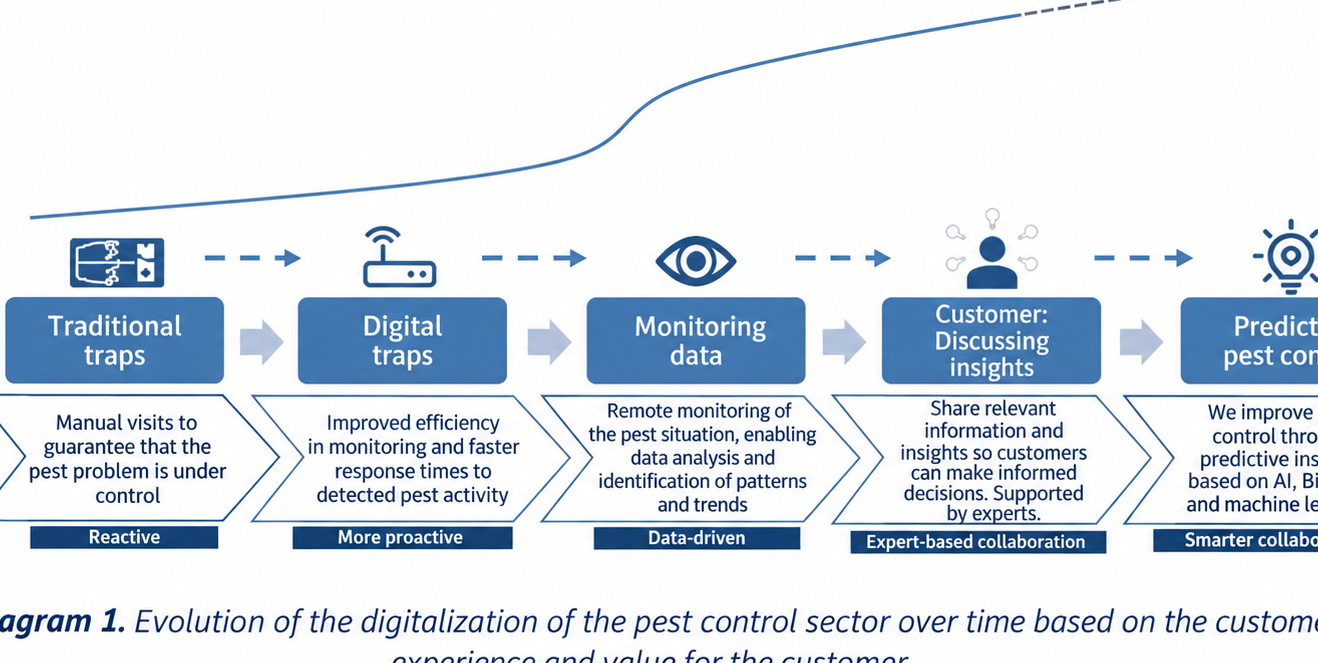
For decades, pest control was viewed as a corrective activity: identify a problem, inspect, apply a treatment, and verify the outcome. This period was closely associated with the acronym DDD - disinfection, insect control, and rodent control - and with an approach in which chemical products played a central role.
Today, the focus has shifted. The industry is driven by integrated pest management, environmental health, remote monitoring, data analysis, and artificial intelligence. This evolution is the result of a combination of regulation, professionalization, restrictions on biocide use, traceability requirements, and technological maturity.
From our experience at Anticimex, this transformation is clear: customers are no longer simply looking to eliminate pests; they want to reduce risk, anticipate problems, and have objective evidence (data) that their facilities are under control (Figure 1).
1. From pesticides to risk management
A key starting point for Spain was Royal Decree 3349/1983, which regulated the manufacture, marketing, and use of pesticides in Spain, with the aim of preventing risks to public health (1, 2).
Subsequently, Royal Decree 1054/2002 introduced the framework for the evaluation, authorization, registration, and marketing of biocidal products, in line with European regulations. This step brought a more rigorous approach to active substances, authorized uses, human exposure, and environmental impact (3).
Finally, consolidation came with Regulation (EU) No. 528/2012, which stipulates that biocidal products must not be placed on the market or used unless authorized in accordance with the regulations, thereby reinforcing the precautionary principle and the protection of human and animal health and the environment (4, 5).
This evolution has pushed the field from a treatment-centered approach toward a broader discipline: risk management and environmental health.
2. Professionalization and traceability
Digitalization cannot be understood without prior professionalization. Royal Decree 830/2010 (4) regulated the training required to carry out biocide treatments, strengthening the technical competence of application personnel (6).
Also relevant has been the Official Registry of Biocidal Establishments and Services (ROESB), managed by the autonomous communities, which regulates the activities of companies and establishments involved in the professional use of biocides (5, 7). This is complemented by the UNE-EN 16636:2015 standard, which defines the requirements for professional pest management services, including assessment, recommendations, control, prevention, and technical competencies aimed at protecting public health, property, and the environment.
At the same time, the first major wave of digitization involved moving from paper to digital records, electronic certificates, control-point maps, and incident histories, since this traceability is essential in sectors such as food, pharmaceuticals, logistics, and healthcare to demonstrate that proper controls are in place. In the food sector, Royal Decree 2207/1995 (8) already emphasized the importance of self-monitoring systems and risk analysis in ensuring food hygiene (3).

3. Integrated pest management: the foundation for change
Digitalization is a natural fit for integrated pest management (IPM), which combines preventive, sanitation, structural, physical, biological, and chemical measures to reduce reliance on insecticides and/or rodenticides. The scientific literature on urban pests emphasizes the need to combine strategies to reduce risks, selection pressure, and the emergence of resistance (9, 10).
In practice, the goal is no longer simply to treat an infestation, but to understand why it occurs; and this is where technology adds value, because it makes it possible to objectively assess activity, measure trends, and prioritize actions. But data does not replace the expert; it empowers them.
4. Sensors, IoT, and remote monitoring
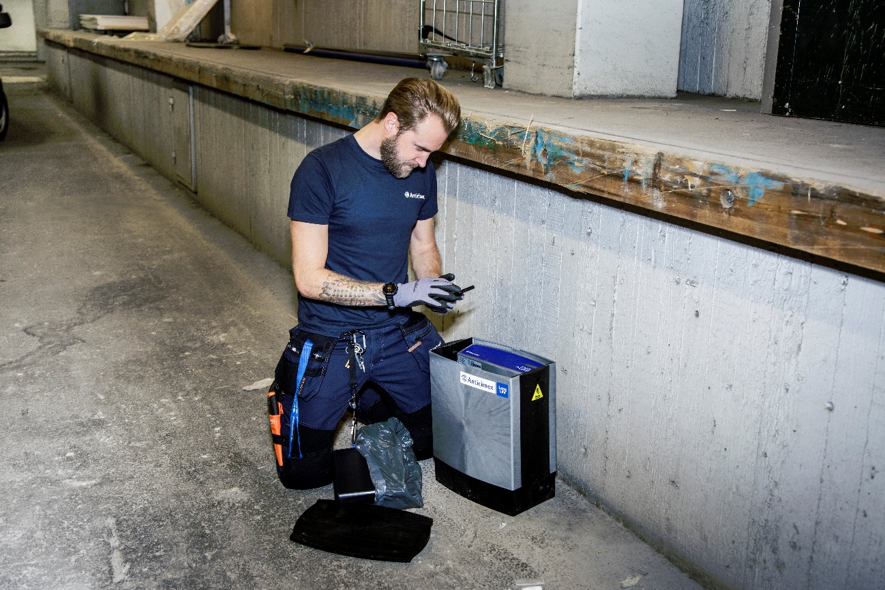
The second major wave of digitalization has arrived with smart sensors, connected traps, cameras, IoT (Internet of Things) networks, and platforms capable of issuing real-time alerts.
For rodents, remote monitoring makes it possible to detect activity without relying exclusively on periodic inspections. A study published in Sensors in 2023 (11) presented a system based on IoT nodes using LoRa technology to monitor infestations, transmit data to the cloud, and generate objective indicators before and after control measures were implemented (11).
Research is also advancing in the use of cameras and machine learning. A study published in Frontiers in Ecology and Evolution in 2024 compared camera traps paired with machine learning models against live trapping for monitoring rodents, finding a higher probability of detection and lower operational effort in the context studied (12)
In insects, automatic detection technologies include infrared and acoustic sensors, computer vision, and artificial intelligence. Reviews published in Agriculture and Sensors indicate that these systems can improve detection and monitoring, although they still have limitations depending on the species, environment, image quality, and data availability (10, 11)
At Anticimex, this transition has been underway since 2012, when the first trials and tests of these types of systems began, as reflected in continuous monitoring solutions such as Anticimex SMART, designed for 24/7 digital pest control using connected sensors, continuous data, and a combination of technology and technical expertise.

5. Artificial intelligence: detect, classify, and predict
Artificial intelligence introduces a qualitative shift: it enables a move from simply collecting data to interpreting patterns at an advanced level. It can analyze information from sensors, recordings, images, historical activity data, environmental conditions, and seasonality to identify relationships that are difficult to detect manually.
Its role can be summarized at three levels:
- Automatic detection: identification of activity using images, sensors, or movement patterns.
- Classification: support in identifying species, activity types, or risk levels.
- Predictability: anticipating areas or times with a higher likelihood of activity.
The scientific literature on AI and IoT applied to pest control focuses on early detection, automated identification, and decision support systems, while emphasizing the need for high-quality data, validation under real-world conditions, and technical oversight (11)
However, we must keep in mind that AI does not replace the technician. An algorithm can flag an anomaly, but it cannot always identify the root cause: a broken utility box, an open door, poor waste management, or contaminated goods. The final decision must continue to be based on inspection, knowledge of the species, and professional judgment.
6. Sustainability and new customer value
In Spain, digitalization is closely linked to sustainability. Various professional associations involved in pest control have highlighted that smart sensors, real-time monitoring, mobile applications, artificial intelligence, and robotics are helping the sector reduce its environmental impact and adapt to a more demanding European regulatory landscape regarding the use of chemical products.
Modern pest management no longer focuses solely on the immediate absence of harmful organisms. It also considers risk reduction, prevention of reinfestation, minimizing the unnecessary use of biocides, traceability, and the protection of people, facilities, and the environment.
Conclusion
The digitalization of pest control is the natural result of increasing professionalization: regulation and evaluation of biocides, professional training, official registries, integrated management, remote monitoring, and artificial intelligence.
The goal is not digitization for its own sake, but better decision-making: intervening earlier (proactively), reducing risks, minimizing the unnecessary use of biocides, documenting actions, and protecting public health and the environment more effectively.
From my position at Anticimex Spain, a leading company in the industry, I see this transformation as an opportunity to raise technical standards: less improvisation, more prevention; fewer generic treatments, more data-driven decisions; less reaction, more anticipation.
Artificial intelligence will play an important role in the future, but the key will remain the same: accurate diagnosis, skilled professionals, and a comprehensive view of risk. That is where digitalization stops being a trend and becomes a true tool for environmental health.
REFERENCES:
1. The Official Registry of Biocidal Establishments and Services in the Autonomous Communities: Ministry of Health - Areas - Coordination Between Government Agencies - ROESB
2. Royal Decree 3349/1983 of November 30, approving the Technical and Health Regulations for the manufacture, marketing, and use of pesticides: BOE-A-1984-1791 Royal Decree 3349/1983 of November 30, approving the Technical and Health Regulations for the manufacture, marketing, and use of pesticides.
3. Royal Decree 1054/2002 of October 11, regulating the evaluation process for the registration, authorization, and marketing of biocidal products: BOE-A-2002-19923 Royal Decree 1054/2002 of October 11, regulating the evaluation process for the registration, authorization, and marketing of biocidal products.
4. Royal Decree 830/2010 of June 25, establishing the regulations governing the qualifications required to perform biocidal treatments: BOE-A-2010-11157 Royal Decree 830/2010 of June 25, establishing the regulations governing the qualifications required to perform biocidal treatments.
5. Regulation (EU) No. 528/2012 of the European Parliament and of the Council of May 22, 2012, concerning the making available on the market and use of biocidal products: BOE.es - DOUE-L-2012-81145 Regulation (EU) No. 528/2012 of the European Parliament and of the Council of May 22, 2012, concerning the making available on the market and use of biocidal products.
6. Zhu, F.; Lavine, L.; O’Neal, S.; Lavine, M.; Foss, C.; Walsh, D. Insecticide Resistance and Management Strategies in Urban Ecosystems. Insects 2016, 7, 2.
7. Miteco 2026: BIOCIDAL PRODUCTS
8. Royal Decree 2207/1995 of December 28, establishing hygiene standards for food products: https://www.boe.es/buscar/doc.php?id=BOE-A-1996-4449
9. Ahmed, S., Marwat, S.N.K., Brahim, G.B. et al. IoT based intelligent pest management system for precision agriculture. Sci Rep 14, 31917 (2024). https://doi.org/10.1038/s41598-024-83012-3
10. Cardim Ferreira Lima, M.; Damascena de Almeida Leandro, M.E.; Valero, C.; Pereira Coronel, L.C.; Gonçalves Bazzo, C.O. Automatic Detection and Monitoring of Insect Pests—A Review. Agriculture 2020, 10, 161. https://doi.org/10.3390/agriculture10050161
11. Lai, S.-C.; Wang, S.-T.; Liu, K.-L.; Wu, C.-Y. (2023). A Remote Monitoring System for Rodent Infestation Based on LoRaWAN. Sensors, 23(9), 4185. https://doi.org/10.3390/s23094185
12. Hopkins, J.; Santos-Elizondo, G. M.; Villablanca, F. (2024). Detecting and monitoring rodents using camera traps and machine learning versus live trapping for occupancy modeling. Frontiers in Ecology and Evolution, 12, 1359201. https://doi.org/10.3389/fevo.2024.1359201
13. Anticimex: Anticimex Smart | 24/7 Digital Pest Control - Anticimex
14. Ministry of Social Rights, Consumer Affairs and the 2030 Agenda (Food Safety): AESAN - Spanish Agency for Food Safety and Nutrition
15. National Association of Pest Control Companies (ANECPLA): About Us